
How Municipal Warrant Questions Route
Match the office to the event. A town police department in Halifax County may know which agency served a paper, but the court creates the docket and controls its orders. Halifax General District Court holds the adult docket for traffic infractions, misdemeanors, and preliminary hearings. A municipal label in a police report does not create a separate searchable court system. One docket serves the whole county.
- Identify the town, date, citation, or case number tied to the incident.
- For an adult traffic or misdemeanor matter, contact the Halifax General District Court clerk.
- Ask whether the case has a hearing date, failure-to-appear disposition, or court order; a case entry is not a warrant confirmation.
- For a service or arrest question, contact the relevant town police department or Halifax County Sheriff.
- For a felony matter, ask the Circuit Court clerk about the court file; discuss any action with counsel.
Halifax and South Boston Dockets Share a County Route
Halifax and South Boston both field municipal police, yet adult criminal and traffic matters still land in the county court system. The Halifax General District Court clerk for criminal and traffic cases is Veresia Wood, at 434-476-3385. That is the first call for a town citation, a missed appearance, or a docket question in Halifax County; have the name plus any summons or case number ready. The clerk can walk you through what the docket shows, though only the sheriff or the issuing court can verify an active warrant. The law library's charter pages for South Boston and Scottsburg describe how each town is organized, but a charter is not a warrant roster and cannot substitute for the court docket. The Virginia South Boston charter spells out the town's municipal structure. A specific case still belongs to the court that entered it.
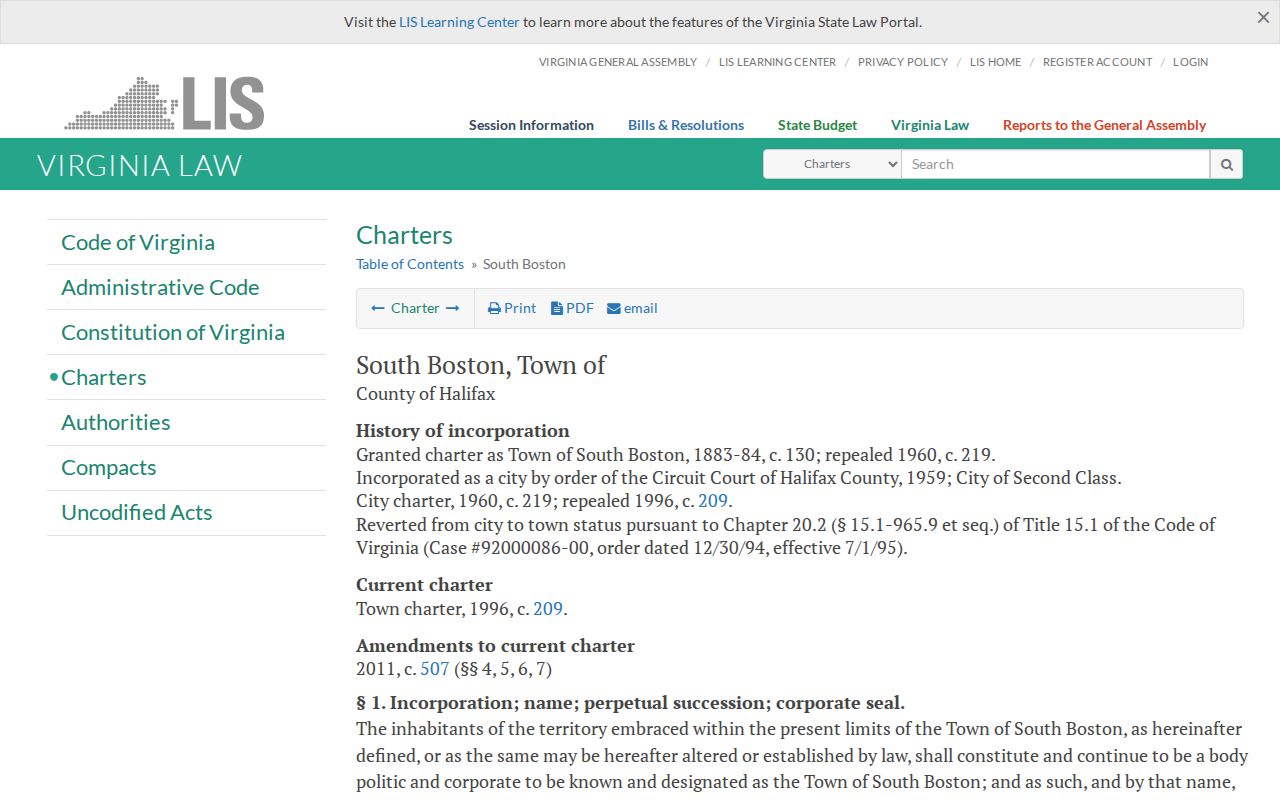
The South Boston charter offers useful background on town authority in Halifax County, but your case still belongs with the court that entered it.
Municipal, Traffic, and Court-Issued Process
People casually call several kinds of paperwork a town warrant. Each has a different issuing authority and a different next step in Halifax County. A traffic summons can put a court date on the calendar without ever being an arrest warrant. A misdemeanor failure to appear can trigger a capias once the judge acts. A search warrant runs on a separate statutory track, and its supporting affidavit is not automatically public at the moment of issuance. So ask which paper you actually hold.
| Record or process | Where to verify | What the label does not prove |
|---|---|---|
| Town traffic summons | Halifax General District Court docket and clerk | That an arrest warrant issued |
| Misdemeanor capias | Issuing court, then serving law-enforcement agency | That an online case result is current |
| Felony arrest warrant | Magistrate or Circuit Court records, as applicable | That the town is the only agency with the record |
| Search warrant | Issuing court and law-enforcement agency, subject to sealing rules | That an affidavit is immediately open |
Halifax Town Police Contact and Adult Court
The Town of Halifax lists its police department as a local contact, with a non-emergency line at 434-476-2526 and service available around the clock. Officers can point a resident toward the right town response, but the department is not a public warrant database. For a pending adult charge, a missed date, a payment, or a court order in Halifax County, use the General District Court clerk's case channel instead. The split matters. One office responds to incidents and serves process; the other keeps the judicial record. South Boston also has an older police listing showing 640 Hamilton Boulevard and 434-575-4273, but its current department page cannot be confirmed, so treat that listing as historical. For adult docket questions, rely on the GDC clerk, and for current agency routing, use the county's official directory.
Small-Town Charters Do Not Create Search Portals
Scottsburg and Virgilina have no separate warrant portal or stand-alone adult town docket. That is simply how it is. Read the court printed on your summons and ask the clerk which agency serves its process. A town charter sets up municipal structure, not live warrant status. For either community, the court name and return date on the citation tell you more than a town-name search ever will. For a broader route through county and state records, see the Halifax County warrant lookup steps.
What to Ask Before Traveling to an Office
A quick phone call settles a lot before you drive anywhere in Halifax County. Ask whether the counter handles the type of record you need, what identifier to have ready, and whether a visit is even necessary. Give the town, the approximate date, the case or summons number, and the name exactly as it appears on the paperwork. A common name alone will not cut it. Ask which court owns the docket, whether the clerk can explain a disposition by phone, and what identification or written request the office needs before releasing a copy.
- For adult traffic and misdemeanor files, ask the GDC clerk about docket access and the next setting.
- For felony circuit matters, contact the Circuit Court clerk, Cathy M. Cosby, at 434-476-6211.
- For juvenile matters or support cases, call the Juvenile and Domestic Relations clerk; access rules differ.
- For an immediate safety issue, call emergency services rather than trying to resolve it through a records counter.
Never send money to a caller who claims a Halifax County warrant can be cleared by gift card, wire transfer, or an online payment link. That is a scam. Confirm any fee with the court, using a number from its official directory.
County Offices Behind a Town Case
Halifax County splits its court clerks by docket: General District for adults, Circuit, and juvenile or domestic-relations matters. The magistrate sits at 1010 Blue Ridge Lane and takes calls at 434-476-2071 for magistrate process questions. The Halifax Adult Detention Center shares that address but has its own number, 434-476-5500. The sheriff's office, at 134 South Main Street and 434-476-3339, serves process and can route agency questions. Keep in mind that a detention roster, a case entry, and a warrant status are three different records. For a municipal traffic or criminal file, start with the court printed on the citation. For the wider Halifax County picture, the Halifax County records home explains which office handles each record class. That handoff saves time, but it does not replace checking town-specific contacts yourself.
Payment Does Not Always Close a Court File Immediately
Paying a Halifax County traffic case takes care with the clock. If the matter is payable through the court, follow the case's official payment instructions and note the deadline. The General District Court guidance is strict: to stop a pretrial failure-to-appear warrant, payment must be finished by 3:30 p.m. on the business day before the scheduled date. Electronic updates may take up to two business days. So keep your receipt. If the online case still looks untouched, call the clerk rather than trusting that a processor has updated the court instantly. One more wrinkle deserves mention. Virginia stopped suspending driver's licenses just for unpaid fines and costs, effective July 1, 2019. That change is narrower than it sounds. It does not erase a balance, cancel a court date, or resolve a capias already issued. A Halifax County case in default needs a direct question to the clerk about what event is recorded. Then speak with a lawyer about your options.
Public Municipal Records Have Limits
Virginia's Freedom of Information Act opens many records held by public bodies. Court records follow their own access rules. A public docket entry can show the court, the charge, and the next date. It is not the whole warrant file. Halifax County readers should know some records stay closed: juvenile law-enforcement records are confidential under Virginia Code § 16.1-301, and sealed records or unexecuted search-warrant materials may be withheld. If access is denied, ask which rule applies.
Access rules to keep in view:
Virginia Freedom of Information Act, Code § 2.2-3700 et seq. sets the public-record framework for state and local public bodies.
Virginia Code § 17.1-208 addresses public access to court records, subject to lawful exceptions.
Virginia Code § 16.1-301 restricts disclosure of juvenile law-enforcement records.
Do not post a private person's name or allegations online because of an unmatched search result. Use official Halifax County channels to resolve identity and status.
When a Town Label and Court Record Differ
Town lines, police jurisdiction, and court assignments do not always match in Halifax County. A stop inside a town can land on a county docket. A county warrant may be served by more than one agency. A charge can even move to a different court later. Check the case number, court name, and date before trusting a town name in an address or news report. For copies or an official status check, find the clerk or agency that holds the actual document. Contact routes and boundaries appear here. Confirmation of an outstanding warrant, though, comes only from the office itself.